
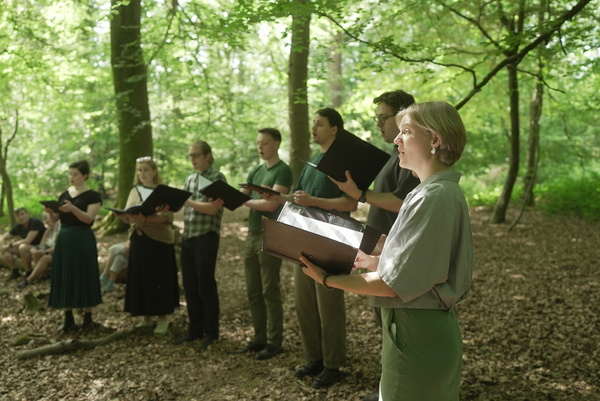
Ahead of Echo Vocal Ensemble’s concert on Friday November 13, we spoke to Echo’s director Sarah Latto about the music that, for many, may be something new and exciting…
Who is Chiara Margarita Cozzolani?
Chiara Margarita Cozzolani is an Italian composer from the 17th century who was cloistered at the Santa Radegonda convent in Milan. Although her life was governed by the restrictions of the convent, she developed a substantial musical career, publishing a number of large-scale sacred music collections, including the Concerti Sacri of 1642 and her Salmi a otto voci concertati of 1650.
I discovered her music about 5 years ago and have been enamoured with it ever since!
What is unique about Cozzolani’s music?
I find the textures in her Vespers setting of 1650 completely unique. Particularly the way she uses duets between voice parts (e.g. two sopranos) and the rhythmic vitality with which she infuses so much of the music. I would describe it as having the scale and textural contrast of Gabrieli alongside the text-setting drama of Monteverdi. The larger-scale movements of the Vespers are written for 8 voices and every voice part is completely vital within the texture.
Which piece in Cozzolani Unbound is your personal favourite and why?
The piece I always return to again and again is Maria Magdalene Stabat. It’s a dramatic dialogue for four voices based around the Easter story, told from the perspective of Mary Magdalene discovering Jesus at the cross. There’s a narrator, Mary’s character and two angels who later tell her good news of the resurrection. I love the drama inherent in the writing – from the devastation of her discovery to the joy towards the end of the dialogue – and the unique vantage point of the protagonist.
What are some key elements of Cozzolani’s music the audience can listen out for?
Listen out for the frequent changes in tempo and texture that keep the larger scale movements of the Vespers (Dixit Dominus, Magnificat Primo, Nisi Dominus) incredibly exciting to listen to. As I mentioned before, she alternates quickly between duets (two sopranos, say) followed by the full 8-part texture, before using another duet of voice parts – which may sound academic on paper but is thrilling in the room. Some of her harmonic choices at the ends of phrases are completely stunning.
How do you plan on using Cozzolani’s music beyond this concert programme?
We’re taking this programme to York Early Music Festival next month, before taking it to St Martin in the Fields in London for International Women’s Day in March 2027, for which we’ve commissioned 3 new works from living composers responding to Cozzolani’s work – from Héloise Werner, Shruthi Rajasekar and Anna Rocławska-Musiałczyk.