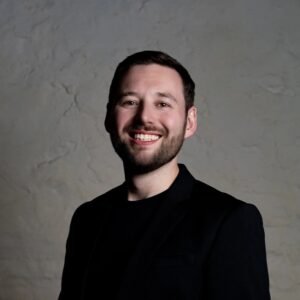
We’re delighted to welcome back The Marian Consort on 16 April, alongside the English Cornett & Sackbut Ensemble, in a programme of Palestrina and Bach. We asked Rory about the joint project, the composers and what to listen out for in the concert.
What is the significance of pairing Palestrina with Bach in this programme?
The idea behind the programme is that there is a direct link between these two giants of the classical repertoire. We know that Bach was aware of, studied and even performed the music of Palestrina, as there are manuscript copies in Bach’s handwriting of some of Palestrina’s music which survive – given how time-consuming/laborious the act of copying was, it shows the great esteem in which Bach held this music. And more than that, we know the performing forces that Bach had in mind, as for one of the pieces, the Missa Sine nomine (which we’re performing) Bach copied out parts for brass instruments alongside the voices and keyboard continuo.
Why was Palestrina so influential?
Palestrina’s music was seen as the pinnacle of the development of Renaissance polyphonic writing, and subsequent generations of composers and theorists lionised it and held it up as the ‘ideal’ of this style, chief among them the 18th Century theorist and composer Johann Joseph Fux, whose hugely influential ‘Gradus ad Parnassum’ (steps to Parnassus) theory treatise of 1725, a guide to writing Renaissance counterpoint known to Bach, is written as a classical dialogue, with Palestrina the wise master and Fux the eager pupil.
What are the main challenges for the singers in the ensemble when performing this music?
One of the challenges is the variety of styles across the programme – although to our 21st Century ears the difference between music of the late sixteenth and early eighteenth centuries isn’t all that great (far less than the difference between say the late sixteenth century and the Rite of Spring, or even Rock or EDM!), the differing approaches required for music by Palestrina, the composers of the early seventeenth century like Gabrieli and Hassler preserved in the Florilegium Portense – this amazing collection of music used as the basis for the repertoire of most of Germany’s liturgical choirs across the seventeenth and eighteenth centuries, including Bach’s choir in Leipzig – and the music of Bach require very careful vocal and musical calibration from both singers and players.
What are you looking forward to about this collaboration with ECSE?
It’s always a treat to combine forces with ECSE – they are such superb musicians, and the depth of sound they bring to this repertoire is just wonderful. They are also so the ideal collaborators for a vocal ensemble, as they are so sensitive to text, the vocal blend and the shaping of the lines, amplifying all of these things that we strive to bring to the audience in performance.
What should the audience listen out for during your concert?
As well as the variety of textures and sonorities possible with voices and early brass, also the stylistic changes mentioned above – these can sometimes be quite subtle, at least to our modern ears, and it’s also fascinating to hear the development of a particular type of musical writing, in this case antiphonal (two groups alternating) double choir writing, which emerged in the second half of the sixteenth century and was then a mainstay for composers all the way to Bach (and beyond!)
What music do you like to listen to outside of ‘work’?
I often have very little choice on this front, as certainly when I’m at home or in the car, the playlist is dictated largely by my children, who have very wide-ranging tastes! So recently, George Ezra, Queen, Fireman Sam and Shakira!
What do you enjoy doing in your free time?
When I’m not immersed in all things choral/early music, I’m an avid cinephile, as my outsize collection of DVDs will attest!